
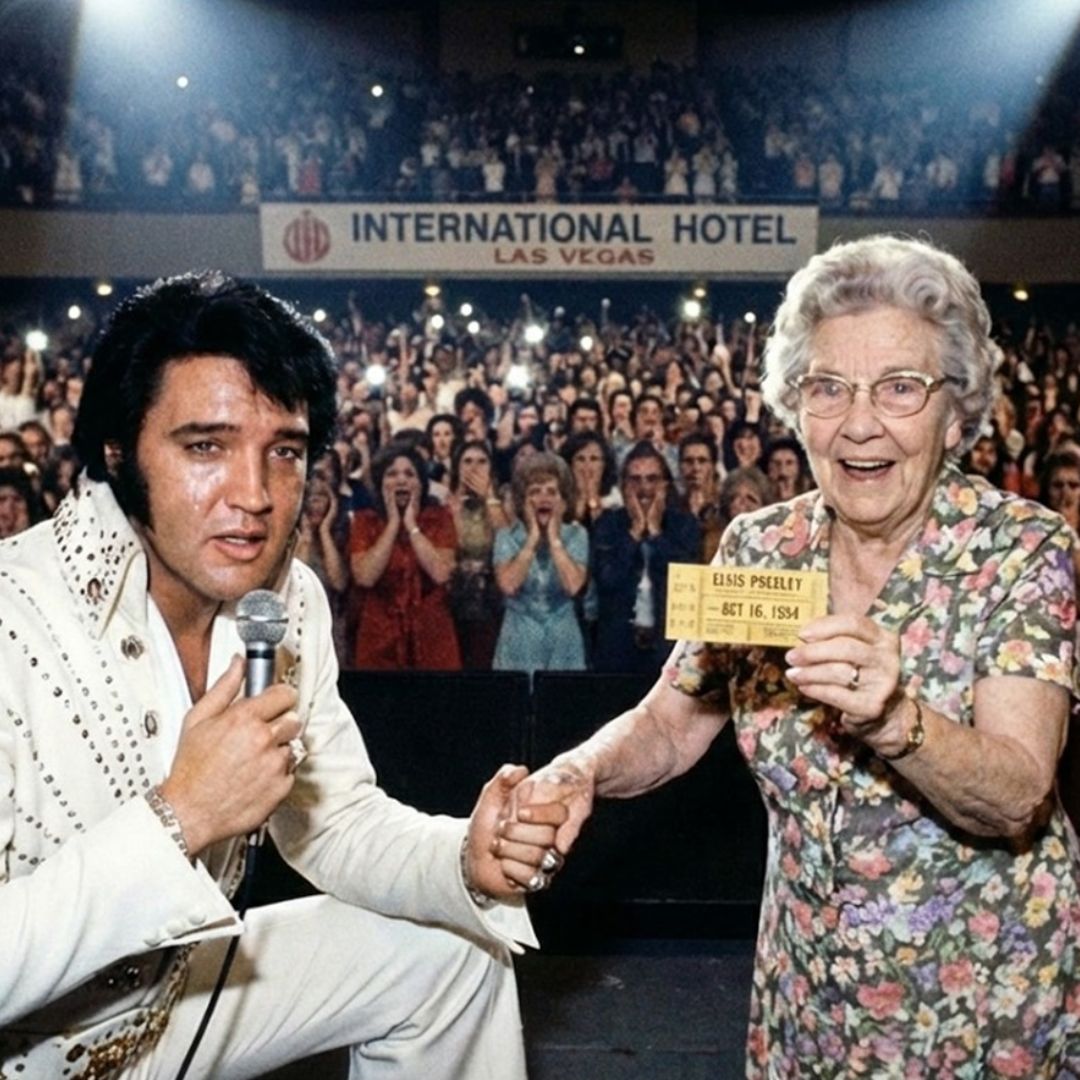
Richmond, 1976. The room was already loud before Elvis Presley even reached the middle of the set. Nearly 18,000 fans were packed into the arena, feeding off every note, every grin, every familiar shake of the shoulders. By then, Elvis Presley was no longer just a singer. Elvis Presley was history, memory, spectacle, and heartbreak all rolled into one human being under the lights.
And yet, in the middle of all that noise, Elvis Presley noticed one face that wasn't trying to compete with the moment.
An elderly woman sat near the front, not screaming, not waving wildly, not trying to be seen. She was simply smiling. Calmly. Steadily. Like someone who wasn't meeting a legend for the first time, but seeing an old chapter of life return for a few precious minutes.
Something about that expression caught Elvis Presley's attention. He paused the rhythm of the show and spoke to her directly. He asked how long she had been a fan.
Her answer changed the temperature in the building.
She told Elvis Presley she had been there since the beginning. Since the summer of 1954. Since Overton Park. Since the days when Elvis Presley was not yet a king, not yet an icon, just a nervous teenager with a voice nobody quite knew what to call.
For a second, the arena seemed to inhale all at once.
Before the Myth, There Was a Boy
The woman's name was Dorothy Hamilton. She did not speak like somebody trying to impress a crowd. She spoke like somebody opening a small wooden box she had kept closed for years. Dorothy Hamilton remembered the details people usually lose first. She remembered the young Elvis Presley looking unsure and electric at the same time. Dorothy Hamilton remembered the nerves in his body, the strange new energy in his legs, the sense that something unusual was happening, even if nobody there could have measured it yet.
It was not the kind of memory that sounded polished. That was what made it land so hard.
Elvis Presley invited Dorothy Hamilton onto the stage.
There are moments in live performance when the stage stops being a platform and becomes something else entirely. That night, it became a bridge between two versions of America: the one that had first watched a shy 19-year-old test his future, and the one now staring at one of the most famous entertainers on earth.
A Tiny Piece of Paper
Then came the part nobody expected.
Elvis Presley, half smiling and half stunned, asked Dorothy Hamilton if she had any proof.
Dorothy Hamilton reached into her purse with the careful motion of someone handling a relic. Wrapped in tissue paper was a fragile old ticket stub, yellowed by time and protected not because it was valuable to collectors, but because it was valuable to her. It had survived moves, seasons, dust, grief, ordinary life, and all the years between a first performance and a final era.
When Dorothy Hamilton held it up, the crowd erupted.
But Elvis Presley did not react like a man looking at memorabilia. Elvis Presley reacted like a man being handed back a forgotten piece of himself.
He took that small ticket stub in his hand and studied it as though the entire weight of his life had somehow been folded into a scrap of paper. The cheers all around him were enormous, but what happened on his face was quiet. His eyes softened. The showman stepped back. The young man from 1954 stepped forward.
"I kept it because I wanted to remember."
Dorothy Hamilton said it simply, without drama. That may have been the most moving part of all.
Why It Mattered
By 1976, Elvis Presley had fame, money, history, and a place in culture that no ticket could buy. But that old stub represented something he could never purchase back: the beginning. Not the polished legend people argued about or the image sold around the world. The beginning. The risk. The fear. The hope. The version of Elvis Presley that existed before success hardened into expectation.
For Dorothy Hamilton, that ticket was proof that she had witnessed the first spark. For Elvis Presley, it may have been proof that the first spark had been real.
No one in that arena could fully hear what Elvis Presley whispered to Dorothy Hamilton next. Maybe that was part of why the story lasted. Some moments are too human to belong entirely to the crowd. But everyone there seemed to understand the meaning anyway. It was not really about a concert ticket. It was about being remembered before the world decided who you were.
And for one night in Richmond, under bright lights and in front of thousands, Elvis Presley held a tiny piece of paper that reminded him he had once been just a scared kid with shaking legs, while Dorothy Hamilton reminded the whole room that sometimes the most valuable thing a person can keep is not fame, but the memory of when it first began.