
Introduction
HE WAS DYING BACKSTAGE — BUT THE SHOW HAD TO GO ON: The Night Las Vegas Saw Elvis, But Not the Man Behind the Curtain
The lights inside the Las Vegas Hilton shimmered like gold dust suspended in the air. Chandeliers glowed, cocktail glasses clinked softly, and a restless crowd leaned forward with anticipation. They had not come to witness vulnerability. They had come to witness greatness. To them, Elvis Presley was not simply a performer — he was a promise that magic still existed in a changing world.
But behind the curtain, the magic felt painfully fragile.
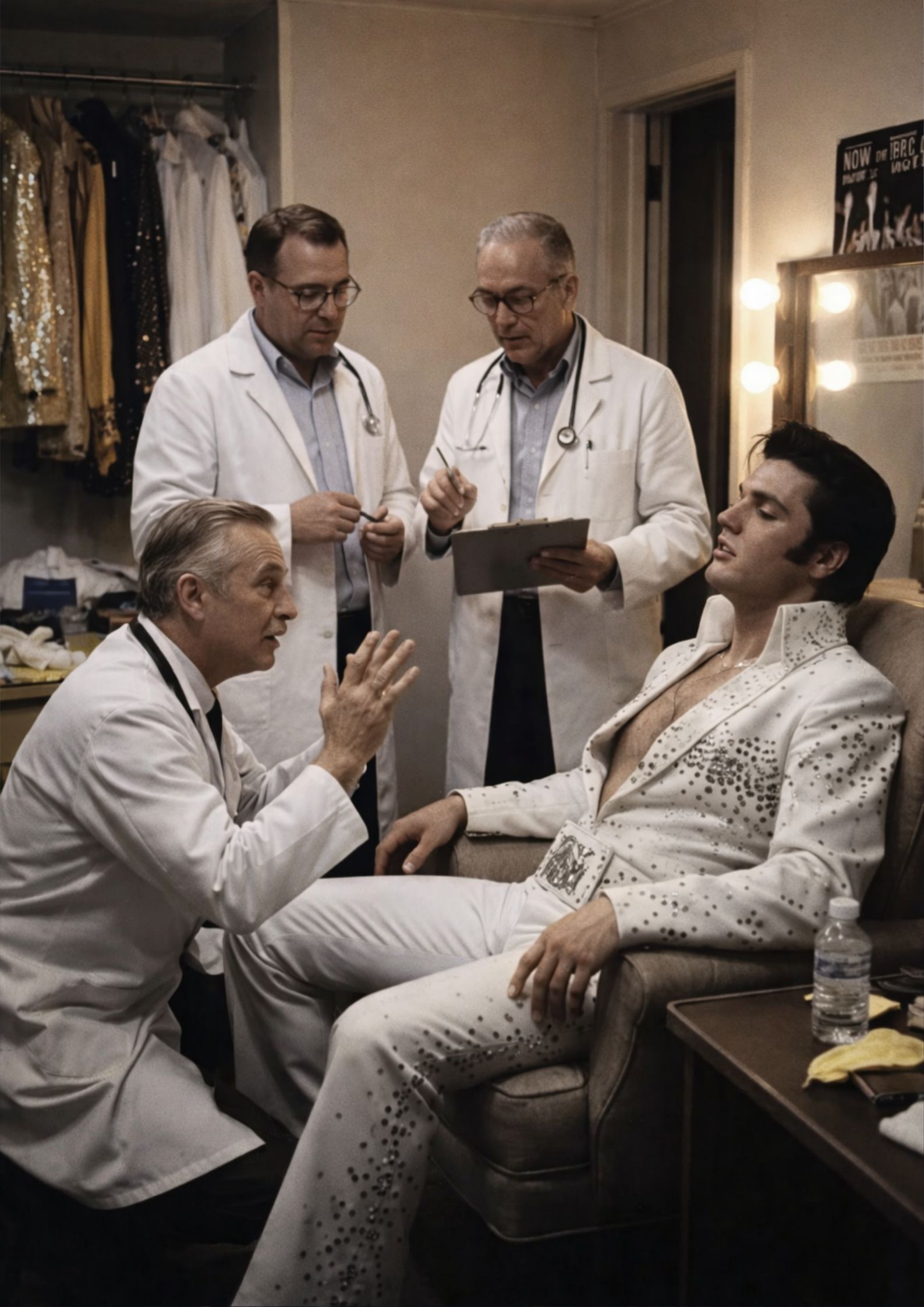
Elvis sat quietly on a narrow couch, the famous jeweled jumpsuit weighing heavily against his shoulders. The room felt smaller than it should have, filled with hushed voices and the low hum of concern. A doctor stood nearby, fingers resting against Elvis's wrist, counting a rhythm that seemed too uneven for comfort. Those present exchanged glances that carried more fear than words ever could. Everyone understood the truth — but no one dared to say it aloud.
"Just give me a minute," Elvis murmured, his voice soft, almost distant.
Las Vegas had built an empire on spectacle. Night after night, glowing marquees promised the King in all his glory — the powerful voice, the swagger, the timeless charm. Yet by the winter of 1976, time had begun to reveal its cost. Years of relentless touring, emotional strain, and dependence on medications had left their mark. Each breath demanded effort. Each step toward the stage felt like walking into a storm he could no longer outrun.
Still, the curtain rose.
The opening notes crashed through the showroom, and the crowd erupted into thunderous applause. From the audience, Elvis appeared larger than life — a silhouette bathed in light, moving with the familiar gestures that had defined an era. But from the wings, he looked different. There was hesitation in his movements, a quiet struggle hidden behind every dramatic turn.

He sang with flashes of brilliance that reminded everyone why they had fallen in love with him decades earlier. A sudden ache in his voice would ripple through the room, drawing cheers and standing ovations. Yet between those moments were pauses — brief lapses in memory, repeated stories, a longer-than-usual grip on the microphone stand. Sweat soaked through the glittering fabric as the heat of the stage lights pressed down like an unforgiving sun.
The audience clapped harder, louder, almost desperately — as if applause itself could hold him upright.
Backstage, tension lingered in the air. The doctor watched closely, silently calculating how much longer a body already worn thin could endure. Those responsible for the business of Elvis — the contracts, the expectations, the relentless machine of entertainment — stood quietly in the shadows. The show had to continue. It always had.
This was the unspoken rule of Vegas: as long as the spotlight shines, the illusion must remain intact.
At one moment during the performance, Elvis paused mid-song, his eyes unfocused as if searching for something beyond the room. The band carried the melody forward, guiding him gently back into rhythm. The audience laughed warmly, assuming it was part of the charm. Few realized how close the performance felt to unraveling.
When the final note faded, the applause felt endless. Fans stood with tears in their eyes, convinced they had witnessed a historic performance. In truth, they had — but not in the way they imagined. They had seen the collision between legend and humanity, between the myth the world demanded and the man struggling quietly beneath it.
As soon as the curtain closed, Elvis's posture collapsed. Hands reached out to steady him before he fell. Towels, water, soft reassurances — the rituals of survival replaced the roar of the crowd. In that private moment, the King disappeared, leaving only a tired man catching his breath, staring down as though searching for a place where he could finally rest.
That night in Las Vegas was not a failure of performance. It was a failure of protection. The lights stayed bright, the tickets sold out, the audience left satisfied — but the person behind the spectacle was left carrying the weight alone.
For many older fans who remember the golden years, this story is difficult to revisit. We cherish the image of Elvis as eternal — confident, magnetic, unstoppable. Yet behind every legendary performance was a human being navigating exhaustion, expectation, and the silent cost of fame.
When the showroom finally emptied and the city lights faded into the desert night, Elvis walked away from the stage having survived another evening — not because he was invincible, but because the world around him never allowed him to stop.
And perhaps that is the part of the story that lingers the longest: the applause may fade, but the quiet courage of the man behind the curtain continues to echo in the hearts of those who truly listened.